Vienna gets dark fast on this walk. This is an offbeat inner-city experience that turns familiar streets into a timeline of murders, court intrigue, and shocking punishments.
I love how the stories are tied to real addresses you can stand in front of, not just vague history. I also love the pacing and the way the guide’s research makes the WOW-moments feel connected, from centuries-old monastery punishment to 20th-century espionage.
One heads-up: the material can get gruesome and it’s aimed more at teens and adults than families who want light sightseeing.
In This Review
- Key things to know before you go
- Why this Vienna crime walk changes how you see the inner city
- The route: start at Albertinaplatz area, finish near Rauhensteingasse
- Capuchin Monastery: dungeons, Father Innocentius, and Emperor Joseph II
- Trattnerhof: the Jaroszynski murder case and Therese Krones’ broken career
- Palais Bathory at Augustinerstraße 12: blood-countess legend vs. political intrigue
- Graben and Kohlmarkt: Demel square, Udo Proksch, and an insurance fraud conspiracy
- Herrengasse: Palais Ferstel and the notorious Zu den Fünf Morden house
- Herrengasse again: Hotel Klomser and Colonel Redl’s spy scandal
- Molker Bastei: Anna Gaugisch and the river-linked mystery
- Am Hof: 1848 war-minister murder and the Wiener October Revolution
- Hannaken-Brunnen: the Hannakenkönig who profited from broken bones
- Maria Am Gestade: the city wall segment and the Zahlheim death penalty
- Hoher Markt to St. Stephen’s: torture, bakers, and quality control that went too far
- Steffl and Himmelpfortgasse: the Plainacher witch story and a nun walled in for love
- The audio guide and guide research: how you get more than just names
- Price and value: what $46.13 buys you in 2 hours
- Who should book this Vienna dark history walk (and who should skip it)
- Should you book this inner-city Vienna crime tour?
- FAQ
- How long is the tour?
- Is the tour offered in English?
- What does the price include?
- Where does the tour start and end?
- Do I need to pay admission at the stops?
- What’s the cancellation policy?
Key things to know before you go
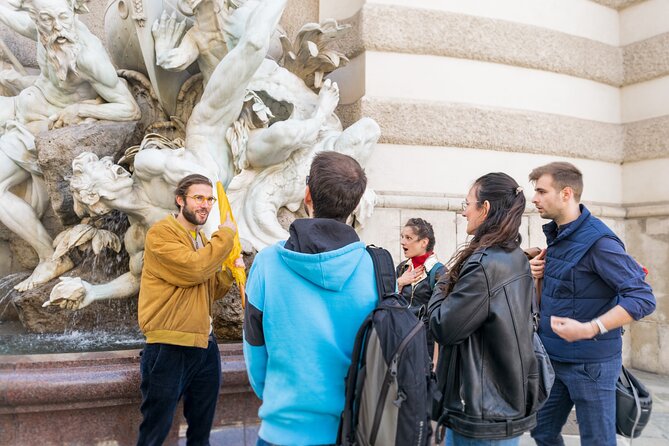
- 14 stops in about 2 hours: short photo breaks, then straight into the story.
- Complimentary smartphone audio guide: use your phone to keep up and re-listen later.
- English tour, small group: up to 20 people.
- Most stops are free to view: each listed hotspot includes free admission.
- Dark history in the most central Vienna: Graben, Herrengasse, St. Stephen’s area, and more.
Why this Vienna crime walk changes how you see the inner city
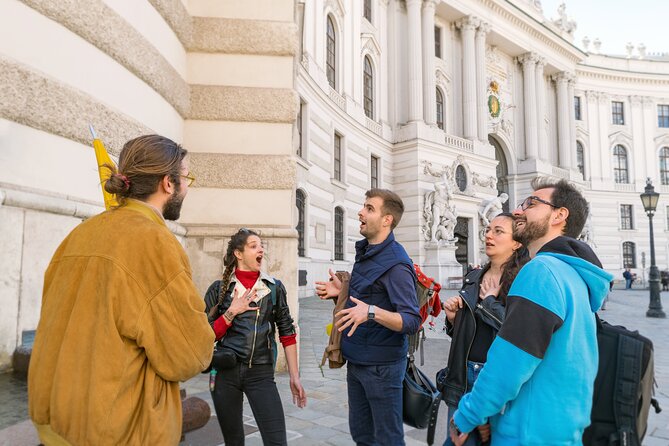
Vienna is all gold light, big facades, and polite distances. This tour flips the lens. Instead of seeing just beauty and borders, you see power, punishment, jealousy, greed, and fear—laid out block by block.
What makes it work for me (and what will work for you) is the structure. You’re moving through the inner city and learning how different eras handled crime and scandal—sometimes through formal law, sometimes through public violence, sometimes through private intrigue that never made the history books the usual way.
The other win is that it’s not a museum crawl. You’re outside, among everyday buildings, which means the stories land harder because you’re standing in the street-level reality of them.
You can also read our reviews of more city tours in Vienna


The route: start at Albertinaplatz area, finish near Rauhensteingasse
You start near Helmut-Zilk-Platz by the Albertina area (Albertinapl. 2-3, 1010 Vienna). You end on Rauhensteingasse (1010 Vienna). That end point matters because it drops you back close to transit and other sights, so you can keep the day going without a long trek afterward.
The walk is designed for short time-on-stop visits—roughly 5 to 15 minutes per story—so you get momentum instead of waiting around. With a maximum of 20 people, it should feel lively rather than crowded.
If you like your tours to stay focused, this one does. You’re not drifting; you’re following a theme.
Capuchin Monastery: dungeons, Father Innocentius, and Emperor Joseph II
The tour opens at Tegetthoffstraße 2 at the Capuchin monastery. Here you hear about the monastery dungeon connected to Father Innocentius—and how monks could be locked away for decades.
The reasons are not always what you’d expect. The story points to “absurd” causes like unauthorized afternoon walks or a one-time abuse of a monastery official. That mismatch between petty rules and life-altering punishment is exactly the kind of psychological realism that makes these tales stick.
The twist is political: Father Innocentius announced the dungeon to Emperor Joseph II, who kept the dungeon closed and moved Innocentius to Lviv for his safety. You also hear about what happened to Innocentius later—Protestant, Freemason, and advisor to the tsar. If you like your Vienna history to include people who fell out of favor, this stop delivers.
Trattnerhof: the Jaroszynski murder case and Therese Krones’ broken career
Next you stop at Trattnerhof to hear the Jaroszynski murder case, and the story’s center is actress Therese Krones. The key idea here is how a person can get pulled into a scandal that isn’t really hers—her career gets destroyed, even if she was drawn in with little real connection to the core crime.
There’s also a big theme of rumor vs. reality. One version says Jaroszynski was driven to despair and crime by Krones and extravagant desires. The story you get on the tour says the more accurate explanation was addiction to games and heavy debt.
This is a good pause in the walk because it adds motive you can feel in real life: the trap of money problems and compulsions. It’s not just sensational violence—it’s how social drama and desperation can collide.
Palais Bathory at Augustinerstraße 12: blood-countess legend vs. political intrigue
At Augustinerstraße 12 you reach Palais Bathory and the famous Bathory name—Elisabeth Bathory, the “blood countess.”
The tour gives you both sides of the narrative. One framing presents her as one of the most dangerous serial killers of all time, with claims she murdered hundreds of virgins and bathed in their blood to preserve youth and beauty. The other framing treats the story as violent intrigue: a countess with dubious loyalty being targeted and eliminated.
I like this stop because it trains your instincts for history. You learn how legends grow, and you also learn that sometimes the “most famous” story isn’t the only possible explanation for what happened at court.


Graben and Kohlmarkt: Demel square, Udo Proksch, and an insurance fraud conspiracy
Now the walk enters the busy, elegant heart of central Vienna—Graben and Kohlmarkt—near the Place of the Demel. This is where the tour switches from personal crime stories to something planned and financially motivated.
You hear about the 1970s role of Udo Proksch and the Lucona affair: a heavily overinsured freighter chartered for Asia with an explosive charge hidden on board. The conspiracy is described as leading to mass murder and massive insurance fraud, and the investigation took years partly because Proksch had relationships in multiple directions.
This stop is valuable because it explains motive in a colder way. It shows you how crime can be engineered like a business project—less about rage, more about calculation and networks.
Herrengasse: Palais Ferstel and the notorious Zu den Fünf Morden house
Two stops share Herrengasse, and both hit medieval Vienna’s darker machinery.
At Palais Ferstel, you learn about the former Zu den Fünf Morden house and one of the most notorious mass murders of medieval Vienna. The punishment is described as extremely severe: the perpetrator was impaled because the deed was considered terrible, including five murders and a seven-year-old victim.
What really sharpens the story is the detail about execution. The executioner is described as not very experienced in that type of execution, so it took an extremely long time. It’s grim, but it shows how punishment was not always clean, quick, or professionally handled—sometimes it was messy state power.
Herrengasse again: Hotel Klomser and Colonel Redl’s spy scandal
Just opposite Palais Ferstel, at the former Hotel Klomser, the story turns to espionage. This is where Colonel Redl’s suicide ends the greatest spy affair of the monarchy, and the tour highlights the stakes: the affair could have been a decisive factor for the First World War.
You also hear how the fallout worked. The discovery of Redl’s espionage destroyed the army’s reputation and exposed vulnerability in the underfunded Evidenzbureau, described as the monarchy’s secret service.
If you’ve ever wondered why spy cases feel like they’re always bigger than one person, this stop gives you the logic. It’s not just intel. It’s trust, credibility, and national credibility.
Molker Bastei: Anna Gaugisch and the river-linked mystery
At Molker Bastei you hear about the murder of Anna Gaugisch. Her boyfriend Raimund Lewisch is described as dismembering her in 1861, with some parts found in the Danube and others here at the nearby location.
The motive given here is personal control. Lewisch is said to have wanted the woman out of the way after she became pregnant. The story also notes that before that, he worked as a blacksmith and dissected another cat, adding a chilling element of escalation and familiarity with brutality.
This is one of the stops where you’ll want to pay attention to your own comfort level. If you’re sensitive to violent crime details, consider whether you want to keep going through all 14 scenes of punishment and harm.
Am Hof: 1848 war-minister murder and the Wiener October Revolution
At Am Hof you get a major political turning point: the lynching murder of war minister Theodor Baillet de Latour during the revolution year of 1848.
The tour frames it as one of the rare cases of political violence in Vienna, and it connects it directly to the beginning of the Wiener October Revolution—the final, far more violent part of the overall revolutionary sequence. The story also adds a practical clue about location: the civil arsenal is in the same place and was looted during the revolution.
This stop matters because it links everyday streets to big historical outcomes. You’re not only learning the crime. You’re learning how one violent moment can reshape a political timeline.
Hannaken-Brunnen: the Hannakenkönig who profited from broken bones
At Hannaken-Brunnen, the story shifts toward dark entrepreneurship. You learn about the surgeon known as Hannakenkönig, who is described as causing broken bones himself to improve business—then healing the injuries.
The method is described as setting trip hazards to provoke accidents. And the story links it to job migration: the Hannaken were a minority from Moravia who often came to Vienna looking for work.
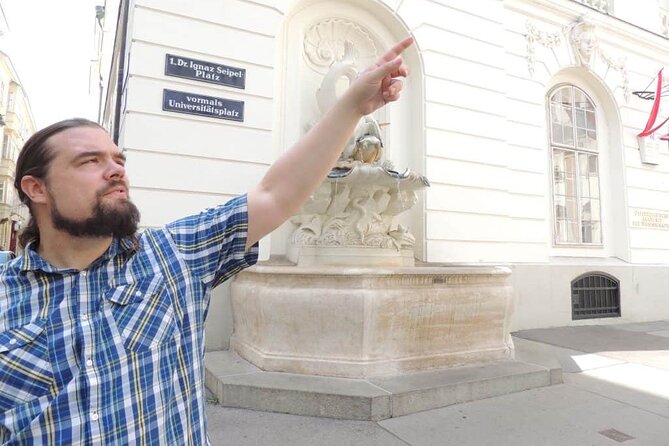
This stop is a clever bit of storytelling because it connects three things—immigration for work, medical services, and criminal manipulation of clients. The fountain depiction you see is described as showing two men carrying an injured comrade to the Hannakenkönig.
Maria Am Gestade: the city wall segment and the Zahlheim death penalty
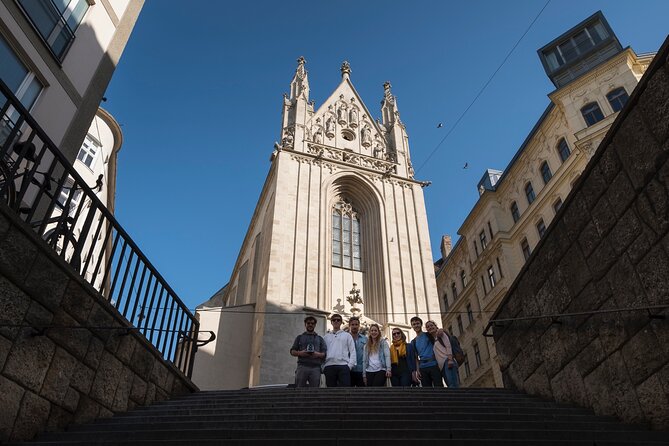
At Maria Am Gestade you reach a section of the city wall where the Zahlheim case took place. The death penalty here is described as the last wheeled execution in Vienna.
There’s an important historical angle: it’s described as extremely cruel and also as something that later stopped being used in most countries. The tour adds that Joseph II usually rejected the death penalty, but the facts in this case forced him to accept it.
This is one of those moments where the architecture helps you believe the timeline. Standing by a wall segment while hearing about punishment makes the history feel less like a paragraph and more like an event you can picture.
Hoher Markt to St. Stephen’s: torture, bakers, and quality control that went too far
At Hoher Markt, you hear the story of Thekla Riener. The tour describes her as tortured, with her husband Anton Grünborn using instruments from the courthouse. She was supposed to betray a supposed lover, but the lover was not actually there. The motive is described as jealousy over imaginary lovers, ending with her being accidentally killed and her parents becoming insane.
Then you move to St. Stephen’s Cathedral and the “baptism of bakers.” The tour frames it as an alleged brutal method of quality control: bakers put in a cage and dipped into the Danube multiple times for bad baking. It also mentions a parallel in English-speaking countries, where punishment for women in disputes is said to have existed.
Whether you take it as legend or literal history, the point is the same: communities enforced standards with violence. This is a hard section, but it’s also central to understanding how “order” was kept.
Steffl and Himmelpfortgasse: the Plainacher witch story and a nun walled in for love
At Steffl you visit the former Malefizspitzbubenhaus, described as the executioner’s apartment and dungeon. Here the tour highlights the only witch burned in Vienna, the Plainacher, who was held and tortured.
You’re told her charge included an epileptic granddaughter bewitched and demons summoned. The story also says witch persecutions weren’t common in Vienna, but this case required the city judge to avoid public pressure—another reminder that law and public opinion were tangled.
Then the tour ends at Himmelpfortgasse, connected to the former Himmelpfort monastery. In 1319, a nun is said to have been walled in because she wouldn’t part with a lover her father hated. The tour frames it like a Viennese Romeo and Juliet: the mayor and his enemy had children who were good friends, and the father’s refusal leads to the punishment of a lifetime.
This finale works well because it switches from public spectacle to private tragedy. It’s still dark, but it has a different emotional weight.
The audio guide and guide research: how you get more than just names
Two things make the tour more useful than a simple walk-through.
First, the included smartphone audio guide gives you a way to track the story if you fall behind at a busy intersection, and it lets you re-check what you heard once you’re back from the street.
Second, the guide experience matters. The tour is led in English, and the guide is known for doing the heavy lifting of the research. I love that because it turns random facts into a narrative: you don’t just get a list of crimes, you get why each story fits the time period.
Price and value: what $46.13 buys you in 2 hours
At $46.13 per person for about 2 hours, this is priced like a real guided experience, not a cheap street history chat. What helps the value is that the stops listed are described as having free admission, so you’re not paying extra at every site.
You’re also getting a structured route with a small group size (up to 20), plus an audio guide. That combination matters when you’re walking central Vienna and you want to make each step count.
Is it a bargain compared to a museum ticket? Not always. But if you’re the type who likes stories with sharp edges and historical context, it’s good value because it’s built like a timeline you can walk through.
Who should book this Vienna dark history walk (and who should skip it)
Book it if you’re curious about the parts of Vienna you won’t naturally notice: monastery dungeons, execution-related locations, political violence in 1848, and court-era scandals tied to specific buildings.
It’s also a fit if you like learning history through consequences. The tour keeps returning to motives—money troubles, jealousy, rumors, and power plays—so you’re not just hearing what happened, you’re seeing the machinery behind it.
Consider skipping if you want a light, family-friendly stroll. The content can get gruesome, and it’s clearly aimed more at teens and adults who can handle darker subject matter.
Should you book this inner-city Vienna crime tour?
If your idea of fun includes the darker side of history, I’d book it. The route is compact, the guide style is focused, and the audio support helps you keep up with a story-heavy walking plan.
If you hate true crime details or you’re here for romantic sightseeing only, you might find the tone too heavy. But if you’re willing to trade gilded postcards for street-level stories, this is one of the more memorable ways to understand Vienna beyond the usual landmarks.
FAQ
How long is the tour?
The tour lasts about 2 hours.
Is the tour offered in English?
Yes, English is offered.
What does the price include?
The price is $46.13 per person and includes a complimentary smartphone audio guide.
Where does the tour start and end?
It starts near Helmut-Zilk-Platz by Albertinapl. 2-3, 1010 Vienna, Austria, and ends on Rauhensteingasse, 1010 Wien.
Do I need to pay admission at the stops?
The listed stops are marked as admission ticket free.
What’s the cancellation policy?
You can cancel for a full refund up to 24 hours in advance. If you cancel less than 24 hours before the start time, the amount paid is not refunded.